
Casazium Tank Command
Six tanks, four targets and a battlefield that is different every time you press F5. A real-time-strategy prototype built in Godot, free to download for macOS, Windows and Linux.
Free, no account, no telemetry. The builds are unsigned, so macOS and Windows will block the first launch — here is how to get past that.
What this is
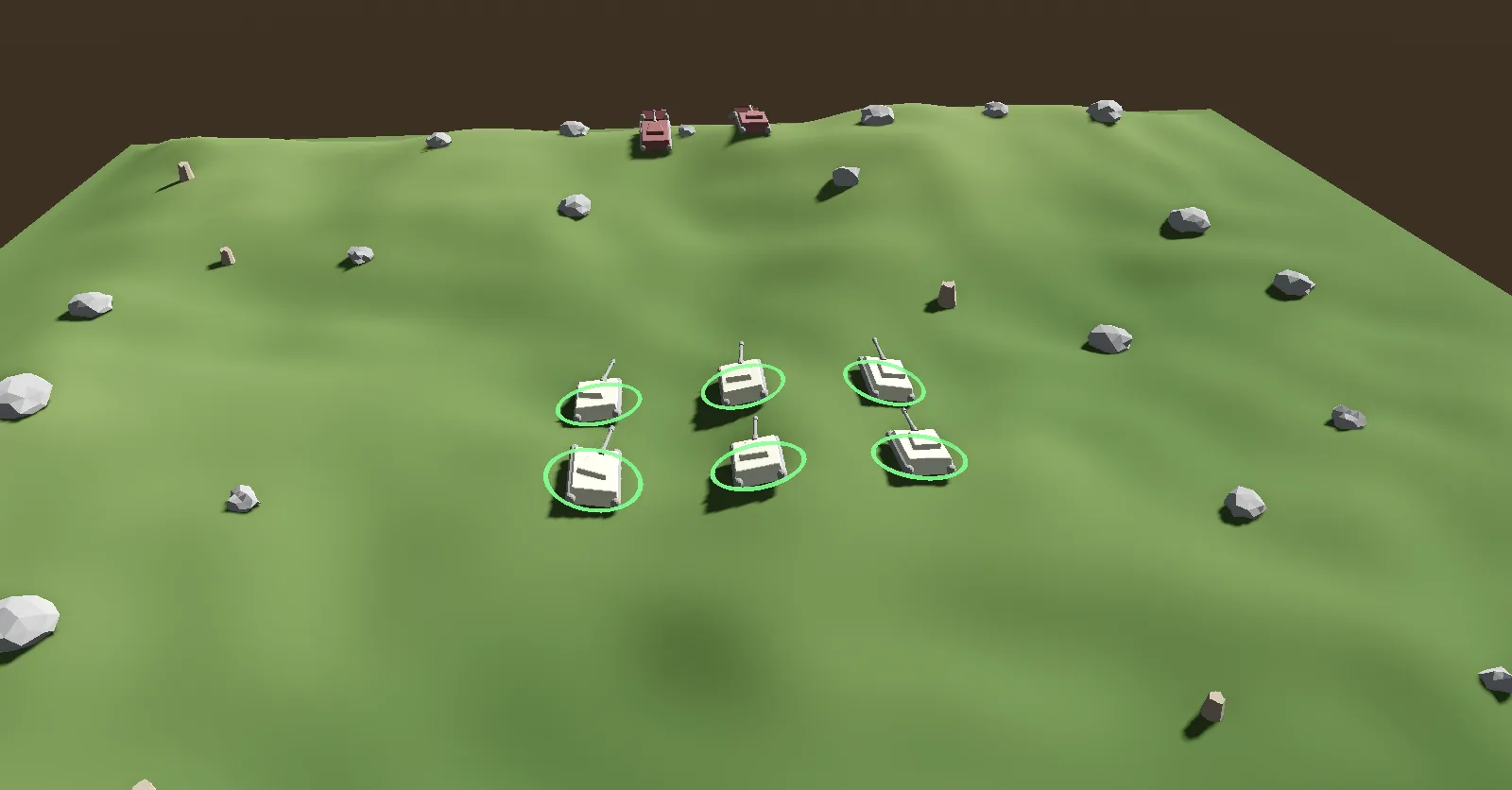
A prototype of the parts of a real-time-strategy game that are hard to fake: terrain that generates itself, units that find their own way across it, and gunnery that solves for a firing solution instead of pretending to. You get six tanks on a 128-metre battlefield, four enemy tanks to shoot at, and a new map whenever you want one. It was built to find out whether those pieces could be made to work together, and they can.
It is not a game. There is no AI — the enemy tanks sit still and take it. There is no sound, no menu, no score, no campaign, and no way to win or lose. Nothing is saved between runs. Treat it as something interesting to drive around for ten minutes, not as something to finish.
Screenshots
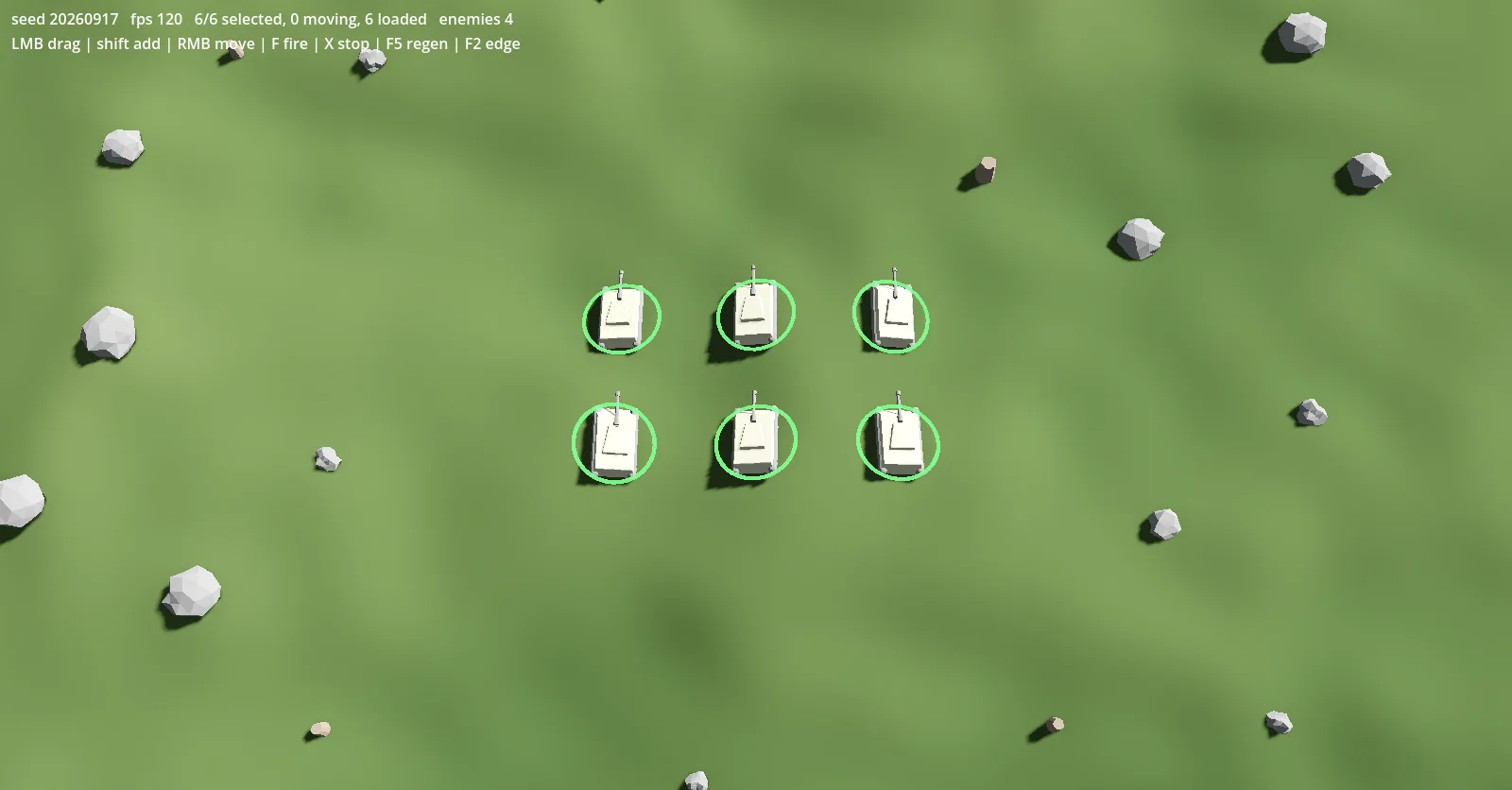
20260917 here — which is the number the entire
battlefield was generated from.
How it works
- Every map comes from a seed
- Terrain, boulder placement and the pathfinding grid all derive from one number, displayed on screen while you play. A map is therefore reproducible from its own screenshot. Press F5 for another.
- Pathfinding is a grid A*, not a navigation mesh
- Godot 4.7.2's navmesh baker returns zero polygons for every input here, verified down to a bare flat quad, so a navmesh was never an option. The grid turned out to be the better fit anyway: the terrain is already one.
- Tanks steer around each other
- They collide with one another and with boulders, and adjust course to avoid both. Avoidance is advisory rather than absolute: when it is the thing preventing an order from completing, it fades out and lets the unit reach its position.
- Gunnery is solved, not faked
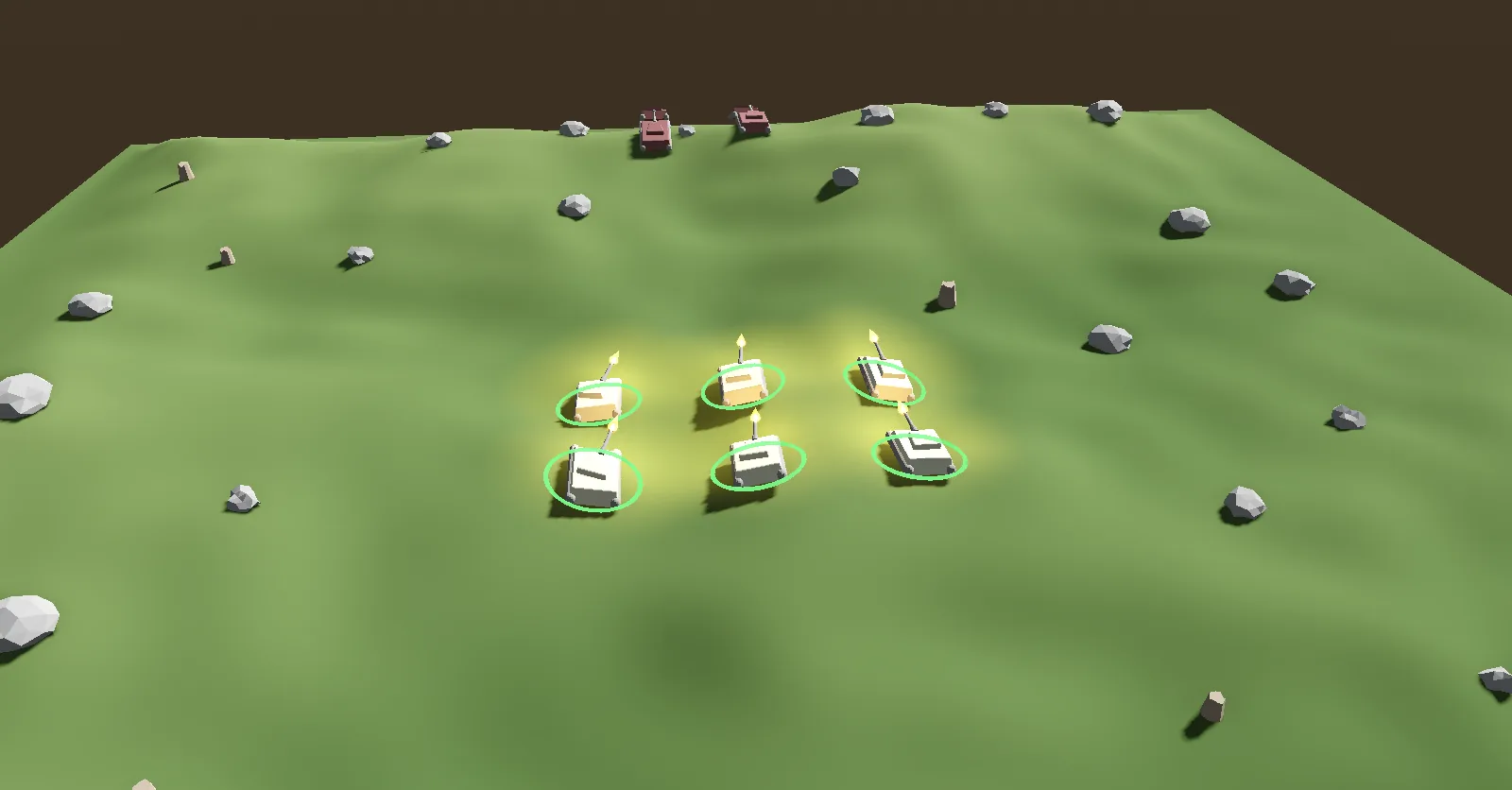
- Barrels elevate to a computed launch angle and shells arc under gravity rather than travelling in a straight line to a guaranteed hit. A shell aimed at a point 49 metres away lands 1.4 metres from it.
- The models are Blender, exported as glTF
- The tank and the scattered rocks were modelled in Blender and brought in as glTF. Everything else on screen — the terrain surface, the selection rings, the shells — is generated at runtime.
Controls
| Input | Does |
|---|---|
| Left-drag | Select units with a box |
| Left-click | Select one unit; hold Shift to add or remove |
| Right-click | Move there — the group spreads into a formation |
| F | Fire (about 2 seconds to reload) |
| X | Stop |
| W A S D / arrows | Pan the camera |
| Q / E | Rotate |
| Mouse wheel | Zoom |
| Middle-drag | Grab the ground and drag it |
| F5 | Generate a new map |
| F2 | Toggle edge scrolling |
| Cmd-Q / Alt-F4 | Quit — there is no menu to quit from |
Edge scrolling is off by default. With it on (F2), moving the mouse near an edge of the screen pans the camera that way. Nothing is drawn on screen either way — it only changes how the camera moves.
Downloads
Version 0.1.0, released 18 Sep 2026. Free, and there is nothing to sign up for.
-
Download for macOS
macOS
SHA-256dbdc9d9e9932affa1f25f27f2aa3752f75fa4e6f8cf674c8d77195109f91734e -
Download for Windows
Windows
SHA-25627ca650f723cadd324c437c56739aeaf5cb836923c856d3c067a0cc9b90d910c -
Download for Linux
Linux
SHA-256a42cc0aaae4277f50875788b7f842e7262ed9a0e3d52d20697ac489d3478b609
Verify a download before running it:
shasum -a 256 CasaziumTankCommand-macOS.zip on macOS or Linux,
certutil -hashfile CasaziumTankCommand-Windows.zip SHA256 on Windows. The
authoritative list is
SHA256SUMS.txt. For an unsigned build this is the only integrity check you have.
Your computer will block this on first launch
Both desktop builds are unsigned. That is not a sign of anything wrong with the file: code-signing certificates cost money per year, and this is a free prototype, so none was bought. Your operating system cannot tell the difference between "unsigned" and "unknown", so it stops the app and warns you. Here is how to get past it.
macOS
You will see “CasaziumTankCommand” cannot be opened because the developer cannot be verified. Right-click the app, choose Open, then click Open in the dialog that follows. You only have to do this once. From a terminal, this does the same thing:
xattr -cr /path/to/TankRTS.appWindows
SmartScreen shows “Windows protected your PC.” Click More info, then Run anyway. The warning names the publisher as unknown, which is exactly what an unsigned build is.
Known limits
- The enemy tanks do not move, aim or fire. They are targets.
- There is no sound at all.
- There is no menu, no pause, no score, and no way to win or lose.
- Nothing is saved. Every launch starts over with a new map.
- Quit with Cmd-Q, Alt-F4, or by closing the window.
- Both desktop builds are unsigned — see above.
Questions, or something broke? Get in touch.